Shop Pay Installments eligibility: what actually qualifies
Shop Pay Installments has hard rules on gateway, market, order value, and product type that most merchants never read until checkout stops offering it.
Shop Pay Installments eligibility: what actually qualifies
Shop Pay Installments requires a single Shopify Payments account in the United States, Canada, or United Kingdom, an order value between $35 and $30,000 (or £50 to £30,000 in the UK), and it excludes gift cards, subscription orders, and B2B transactions. Meeting those requirements gets you access to the feature, but it doesn't guarantee any individual customer gets approved for it.
Search "shop pay installments eligibility" and the results are almost entirely Shopify's own help center, a page from Affirm, and one Shopify Community thread from a merchant asking why installments suddenly stopped showing at checkout. Nobody has written the plain-English version of what actually qualifies, which is strange for a feature this widely used.
We build Payment Plans (by PreProduct), a merchant-funded alternative to lender-backed BNPL, so we have an obvious interest in merchants understanding their options. We'll stick to what's documented. This guide covers the account-level requirements, the order-value range, what's excluded outright, the one restriction most merchants get wrong, and where a merchant-funded plan fits when Shop Pay Installments doesn't.
Key Takeaways - Shop Pay Installments requires Shopify Payments as your gateway, Shop Pay activated, and a single account in one market at a time (US, Canada, or UK). A third-party gateway disqualifies you entirely. - Orders must fall between $35 and $30,000 USD/CAD, or £50 and £30,000 GBP in the UK, including shipping and tax. - Gift cards, subscription orders, and B2B transactions are excluded outright, and Shopify can suspend access for regulated or prohibited product categories. - Made-to-order and long-lead-time products are not banned. Shopify requires specific disclosure messaging instead, which most merchants never see until they go looking for it. - Meeting every requirement doesn't guarantee approval. Affirm underwrites each transaction individually, in real time.
What Shop Pay Installments actually requires
Shop Pay Installments isn't a standalone product a merchant switches on. It's layered on top of Shopify Payments, and that dependency is the first eligibility gate most merchants don't expect.
To offer it, a store needs Shopify Payments and Shop Pay both activated, with a single Shopify Payments account whose currency matches the merchant's business location: USD for a US entity, CAD for Canada, GBP for the UK. A merchant running a third-party gateway instead of Shopify Payments can't offer Shop Pay Installments at all, because every transaction routes through Shopify Payments regardless of which processor handles the rest of the store.
That also means one market at a time. A merchant selling into the US and UK from the same store can't run Shop Pay Installments across both simultaneously, because it's tied to a single Shopify Payments account in a single currency.
Want the full landscape of what sits between you and a lender-free setup? Read the seven alternatives to buy now, pay later for merchants.
The order-value range, and what falls outside it
Eligible orders run from $35 to $30,000 USD or CAD, or from £50 to £30,000 GBP in the UK, inclusive of shipping and tax. An order below the floor or above the ceiling simply won't show the option at checkout, and there's no merchant-side setting to widen it.
| US / Canada | United Kingdom | |
|---|---|---|
| Minimum order value | $35 | £50 |
| Maximum order value | $30,000 | £30,000 |
| Currency | USD / CAD | GBP |
For most stores this range is generous. It becomes a real constraint at the edges: a $28 add-on won't qualify, and neither will a custom five-figure commission that clears the ceiling. Both cases are common in the made-to-order and high-AOV categories that lean on payment plans most.

What's excluded outright
Some categories aren't a matter of order value. They're excluded from Shop Pay Installments regardless of price:
- Gift cards
- Subscription orders
- B2B transactions

Beyond that flat exclusion list, Shopify and Affirm can suspend a merchant's access entirely if the business is primarily B2B, sells in a category Affirm doesn't support (gambling, financial services), or sells regulated or prohibited goods such as tobacco, drug paraphernalia, currencies, or weapons.
If your catalog or business model touches any of this, the honest answer is that Shop Pay Installments isn't available to you, full stop, and no amount of configuration changes that.
Made-to-order and long-lead-time products: allowed, with a catch
This is the restriction most merchants get backward. It's easy to assume Shop Pay Installments is for in-stock, ship-today products only, and that anything with a long production or fulfillment window is quietly excluded. It isn't.
Shopify's own guidance addresses this directly for products it describes as taking longer than 30 days to fulfill, including handcrafted and made-to-order items. Rather than blocking them, Shopify requires specific disclosure messaging on the product page: customers need to be told that their first installment is charged roughly two weeks after purchase, which may be before the item ships.
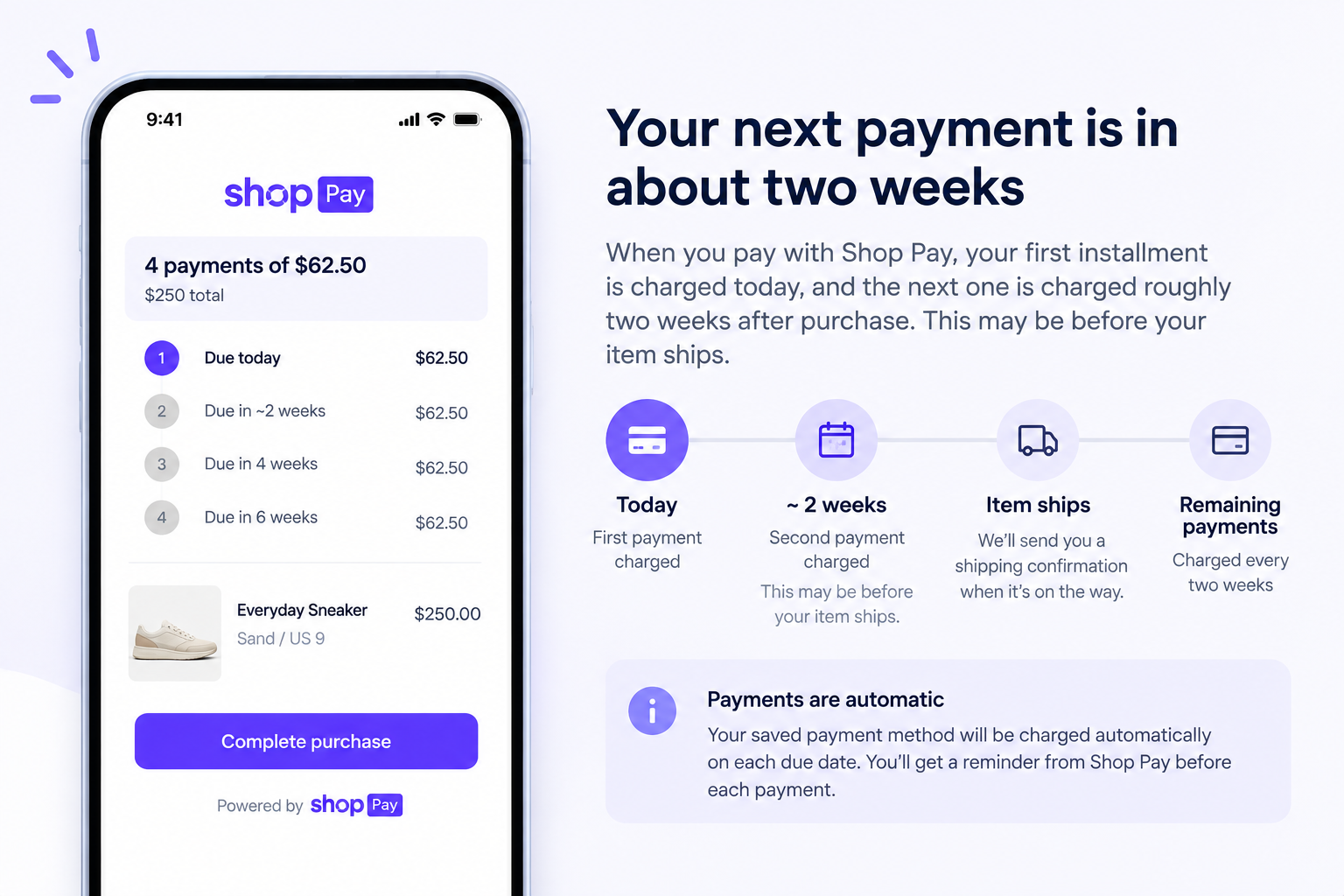
That's a materially different requirement than an outright ban, and it's worth knowing either way. If you sell custom or made-to-order goods, you can offer Shop Pay Installments, but you're on the hook for disclosure copy that most product-page templates don't include by default, and for a customer experience where the first payment lands well before anything moves.
Why eligibility doesn't guarantee approval
Everything above determines whether Shop Pay Installments is available on an order. It says nothing about whether an individual customer gets approved for it, because that decision belongs to Affirm, not the merchant.
Affirm underwrites each transaction in real time using a model that expands five basic inputs into more than 500 data points, rather than a single static credit check. The disclosed APR range is 0% to 36% in the US and 0% to 31.99% in Canada, with short pay-in-4-style plans typically at 0% and longer monthly financing spanning the fuller range. A customer can be approved for one order and declined for another, and neither the merchant nor the customer sees the underwriting logic that decided it.
The cost side of this is deliberately not what Shopify publishes anywhere. We've covered what BNPL providers, including Shop Pay Installments, actually charge merchants in detail elsewhere; the short version is that the transaction fee is visible only in your own Shopify admin, and it isn't refunded when you refund the order.
Where a merchant-funded plan fits when Shop Pay Installments doesn't
None of this makes Shop Pay Installments a bad option; for stores that clear every requirement above, it's a fast, no-setup way to offer pay-over-time with the collection risk sitting on Affirm rather than the merchant. But the requirements are real, and a meaningful share of Shopify Plus merchants sit outside at least one of them.
A merchant-funded plan works differently because there's no lender's eligibility rules to clear in the first place. With Payment Plans (by PreProduct), the customer pays you directly through Shopify checkout: the first installment is charged at checkout, the card is vaulted securely, and the remaining installments are charged automatically on a schedule you set. The order stays on a fulfillment hold and ships only once the balance is fully paid.
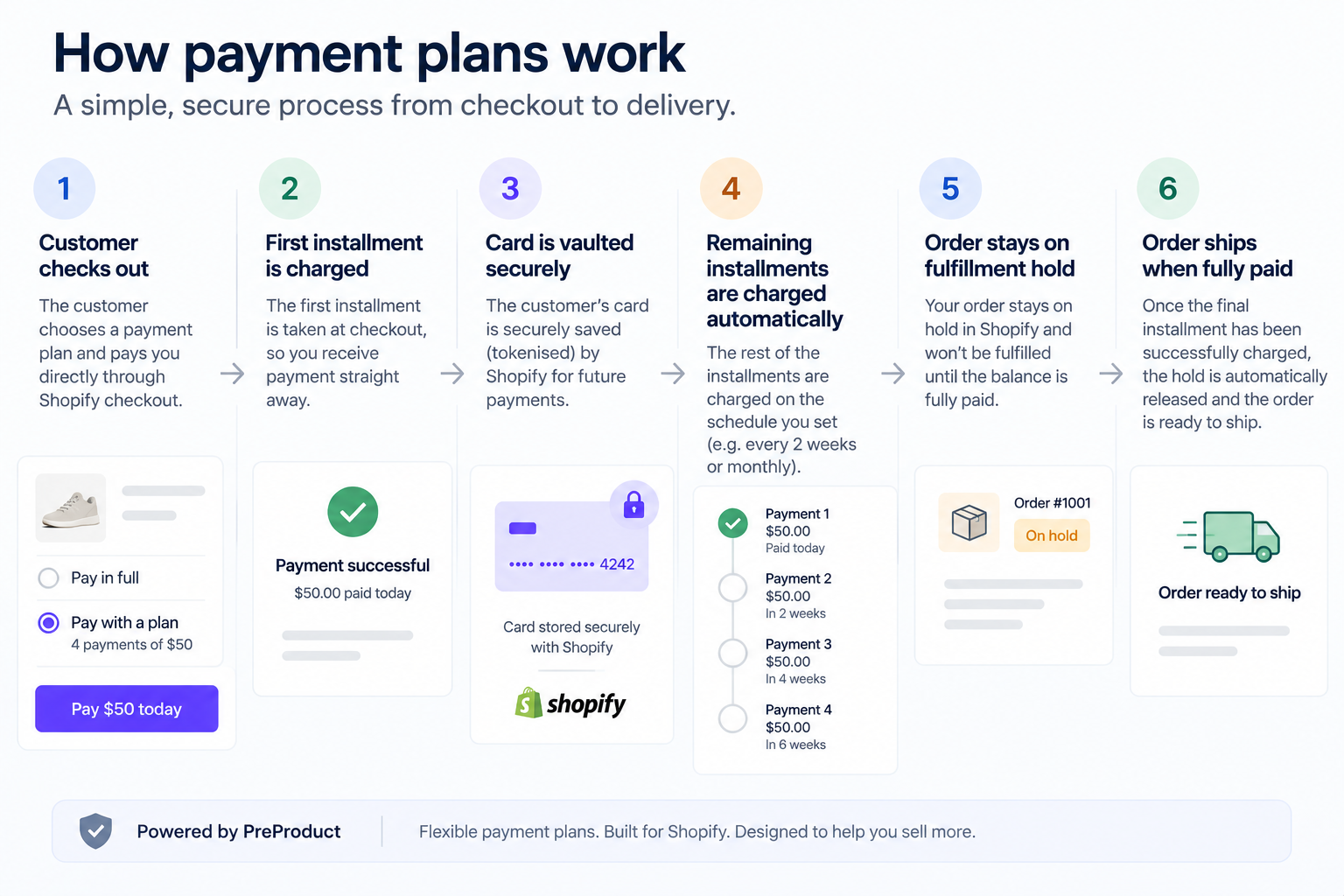
That structure changes which of the constraints above still apply:
| Constraint | Shop Pay Installments | Merchant-funded plan |
|---|---|---|
| Payment gateway | Must be Shopify Payments | Also runs through Shopify Payments — this constraint doesn't go away |
| Order value range | Fixed $35–$30,000 (or £50–£30,000 UK) | You choose the minimum and maximum |
| Gift cards, subscriptions, B2B | Excluded outright | Not categorically excluded by the app; a subscription-style recurring product is still outside what Payment Plans is designed for |
| Approval | Affirm underwrites each transaction | No credit check; you set the eligibility rules |
| Made-to-order / long lead-time goods | Allowed, with required disclosure copy | A core, well-supported use case |
Payment Plans is built for high-AOV, made-to-order, and custom-order Shopify Plus catalogs specifically, which is exactly the segment most likely to bump into Shop Pay Installments' order-value ceiling or its underwriting decline. It doesn't perform a credit check, because there's no lender in the transaction to run one.
The honest tradeoff runs the other way: you're paid as installments come in rather than upfront, and the product doesn't ship until the balance clears. Shop Pay Installments' genuine advantage is that it removes both of those constraints for the orders it accepts. Which model fits depends on whether your catalog and cash flow can work with delayed payment in exchange for not depending on a lender's rules.
Payment Plans requires Shopify Plus. Payment Plans does not provide a loan or perform a credit check. Merchants should confirm that their payment-plan terms, disclosures, cancellation policy, and local setup meet the requirements that apply to their business.
Curious how the mechanics compare end to end? See how Shopify payment plans work and which route fits your store.
Frequently asked questions
What does Shop Pay Installments require to be eligible?
A single Shopify Payments account with Shop Pay activated, a business entity in the US, Canada, or UK, and orders between $35 and $30,000 (or £50 to £30,000 in the UK). Gift cards, subscriptions, and B2B orders are excluded regardless of value.
Can I use Shop Pay Installments with a different payment gateway than Shopify Payments?
No. Shop Pay Installments transactions route through Shopify Payments regardless of what other gateway a store uses elsewhere, so a merchant not on Shopify Payments can't offer it at all.
What's the minimum and maximum order value for Shop Pay Installments?
$35 to $30,000 in the US and Canada, or £50 to £30,000 in the UK, including shipping and tax. There's no merchant-side setting to change this range.
Can I offer Shop Pay Installments on made-to-order or long-lead-time products?
Yes. Shopify doesn't exclude products that take longer than 30 days to fulfill, but it requires disclosure messaging on the product page stating that the first installment is due roughly two weeks after purchase, which may be before the item ships.
Can I use Shop Pay Installments for subscriptions or B2B orders?
No. Both are excluded outright regardless of order value or product type, and Shopify can suspend a merchant's access entirely if the business is primarily B2B.
Does meeting every eligibility requirement guarantee a customer gets approved?
No. Eligibility determines whether Shop Pay Installments is offered on an order at all. Whether an individual customer is approved is a separate, real-time underwriting decision made by Affirm.
The takeaway
Shop Pay Installments eligibility comes down to five things: Shopify Payments as your gateway, one market at a time, an order value between $35 and $30,000, no use of gift cards, subscriptions, or B2B, and disclosure messaging if required if your fulfillment takes longer than 30 days. Clear all five and the feature is available. It still doesn't mean every customer gets approved, since that decision sits with Affirm's own underwriting, transaction by transaction.
If your store sits outside one of those requirements, or you'd rather set your own eligibility instead of clearing a lender's, that's the gap a merchant-funded plan is built to fill. See how Payment Plans works for Shopify Plus, or install Payment Plans from the Shopify App Store.
Get started today
Ready to Bring Payment Plans In-House?
Join the first 50 Shopify Plus merchants to lock in founding pricing.
Try for free →