Layaway vs. BNPL: what's actually different
Layaway and BNPL solve opposite problems: one holds the product until it's paid off, the other ships it first. Here's the real difference, and where a merchant-funded Shopify payment plan fits between them.
Layaway vs. BNPL: what's actually different
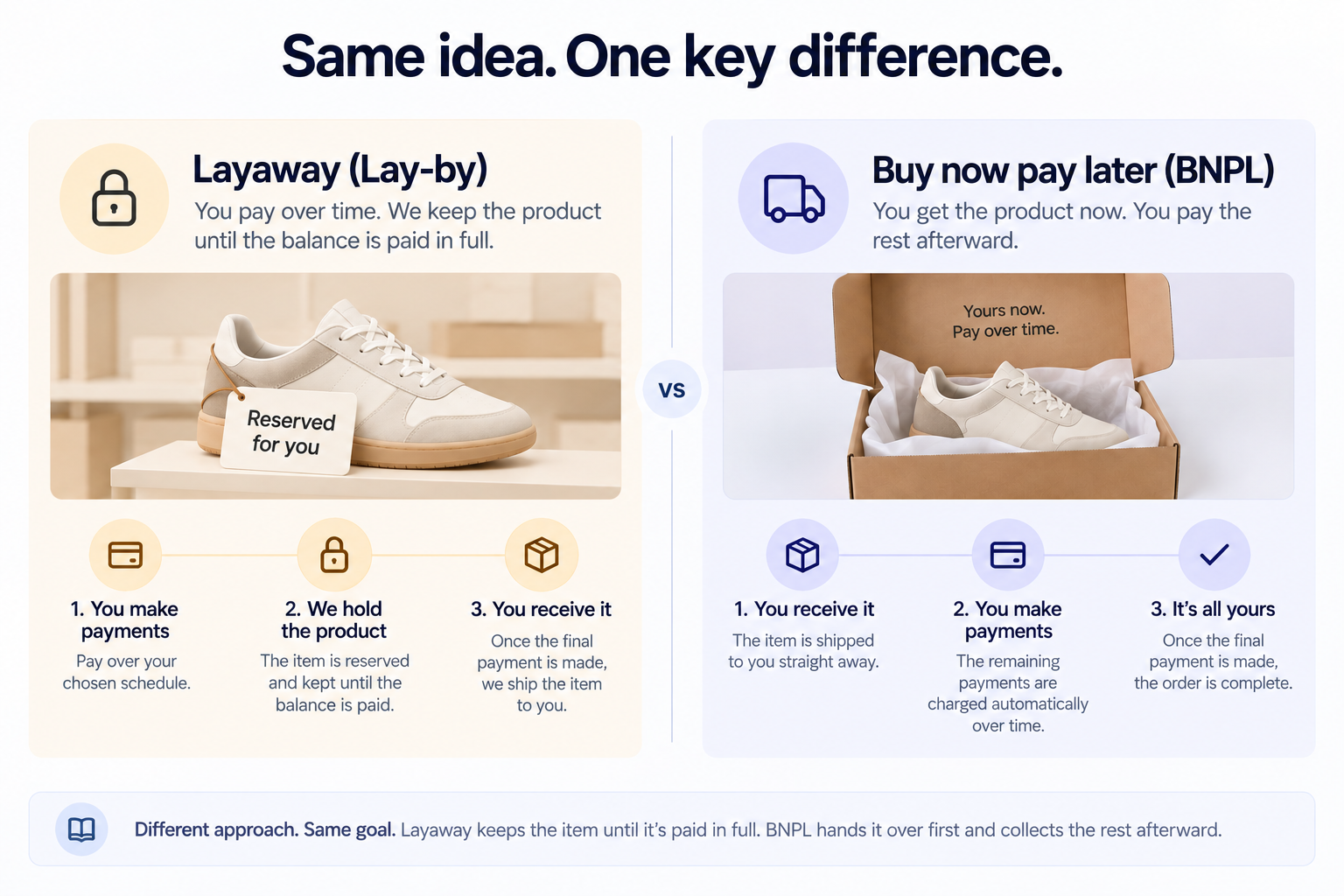
Layaway (also known as Lay-by) and buy now pay later (BNPL) split on exactly one point: who's holding the product while it's still being paid for. Layaway keeps the item until the balance hits zero. BNPL hands it over first and collects the rest afterward.
It's an odd thing to have to explain, because for decades layaway was the deferred-payment option, full stop. Then, almost overnight, the model retailers had run for a century got treated as an embarrassing relic, and the one that ships first and collects later became the default.
The strange part is that the "modern" option is the one that puts someone on the hook for goods they might never finish paying for. The "old-fashioned" one never was.
We build Payment Plans (by PreProduct), a merchant-funded alternative to lender-backed BNPL, so weigh that against everything below. If you'd rather see the product first, here's how Payment Plans works; otherwise, this guide defines layaway and BNPL fairly, shows where the real structural difference sits, and covers where a merchant-funded plan lands between the two.
Key Takeaways - Layaway and BNPL differ on one axis: layaway ships after the balance is paid in full, BNPL ships immediately and collects the rest over time. The FTC states this plainly. - The Consumer Financial Protection Bureau (CFPB) defines the most common BNPL structure, "pay-in-4," as a four-payment loan with no interest. It's a loan. Layaway never has been. - Walmart is the clearest real-world data point on the trade-off: it replaced its interest-free layaway program with Affirm-powered BNPL ahead of the 2021 holiday season, swapping a deposit-and-wait model for one where some Affirm plans carried APRs up to 30%. - A merchant-funded Shopify payment plan borrows a rule from each model: it pays the merchant over time like BNPL, and it holds fulfillment until the order is paid off like layaway. - Neither layaway nor a merchant-funded plan runs a credit check or charges interest. BNPL, structurally, usually does one or both.
What's the difference between layaway and BNPL?
Layaway holds the product until the customer finishes paying for it. BNPL gives the customer the product right away and collects payments afterward. Everything else people associate with each one, a deposit at a store counter for layaway, a four-payment split at checkout for BNPL, follows from that single decision about when the item changes hands.
The FTC's consumer guidance draws the same line: with layaway, "you put down a deposit... you have a short period of time... to pay the rest of the cost," and only "after you pay in full" do you get the item. BNPL reverses that order entirely.
The risk moves with it. Under layaway, the store carries a held product and an unpaid balance. Under BNPL, a lender carries the unpaid balance while the customer already has the goods.
How BNPL actually works
The BNPL structure most people mean is "pay-in-4." The Consumer Financial Protection Bureau (CFPB) describes it as a four-payment loan with no interest: the first installment is due at checkout, the customer takes the product home the same day, and the lender collects the remaining three payments over the following weeks. Longer BNPL plans, the kind used for higher-ticket purchases, can carry real interest instead of splitting the price four ways for free.
Either version rests on the same commercial arrangement. The provider pays the merchant the full order value upfront, minus its fee, and then owns the job of collecting from the customer. If the customer stops paying, that's the provider's loss, not the merchant's, which is the entire reason the merchant fee exists.
Consider a hypothetical: Jordan orders a $900 electric bike from a Shopify store using a BNPL widget at checkout. The bike ships the next day, and Jordan pays the provider back over six weeks.

When Jordan's third payment fails, the merchant never hears about it. Jordan's bike is already Jordan's problem financially, and the provider's problem contractually. The merchant was paid in full on day one and has moved on.
Curious what that arrangement actually costs the merchant? We broke down what BNPL providers really charge, since none of the major providers publish a rate card.
How layaway actually works
Layaway runs the opposite transaction. The customer puts down a deposit, the store holds the item, and the customer pays the remaining balance across a set window, historically 30 to 90 days. No interest changes hands, because there's no lender in the transaction to charge it. No credit check happens, because nobody is extending credit; the store is simply agreeing to wait.
Sears and Kmart both ran layaway programs for most of the 20th century, and mainstream retail layaway survived, in a shrinking form, into the 2020s. Walmart's exit is the cleanest data point on why it disappeared. Ahead of the 2021 holiday season, Walmart discontinued its seasonal layaway program and replaced it with Affirm-powered financing, moving customers from interest-free deposits to loans carrying APRs as high as 30%, with some promotional items at 0%.
Consider another hypothetical: Renata runs a home goods store on Shopify Plus, four years in before she'd ever heard the phrase "buy now, pay later." Before that, when a customer wanted a $2,000 dining set they couldn't pay for in one visit, she wrote their name on a sticky note, taped it to the crate in the back room, and let them pay it off over three visits. It worked, but it also meant a chunk of her floor space sat unsellable for months, and she saw zero revenue from that sale until the last payment cleared. That's the retailer's-eye view of why layaway lost.

Why retailers traded layaway for BNPL, and why that trade doesn't map onto Shopify
From a retailer's side, BNPL solved two real problems layaway created: it gets the full order value in the door on day one instead of over weeks, and it frees up inventory that layaway had tied down in a back room. That's a genuine improvement to cash flow and shelf turnover, and it's the reason big-box retailers made the switch.
What that trade quietly moved is the risk of the customer not paying. Under layaway, an unfinished plan costs the store an unsold item and some wasted shelf time. Under BNPL, an unfinished plan is a loan the customer already has to work off, on merchandise they already possess, at a rate the provider set.
The CFPB's ongoing research into BNPL flags this directly: the product's structure can leave borrowers stacking multiple pay-in-4 loans at once, a risk a store's own layaway shelf never created, since it only ever tied up one purchase's worth of credit, none of it borrowed.
None of that math improves for a Shopify Plus store selling $2,000 furniture instead of $80 sneakers. The merchant still pays a provider fee on every order, whether or not the plan finishes, and still hands the customer relationship, and the collection risk, to a company that isn't the merchant. For a high-AOV catalog, that fee is the whole ballgame; what BNPL providers actually charge runs the numbers.
Merchant-funded vs. lender-funded installments: where Payment Plans fits
A merchant-funded plan is what happens when you keep layaway's one good idea and drop the paperwork. The customer pays the merchant directly, in installments, through a single Shopify checkout. There's no lender, no credit check, and no separate BNPL provider fee sitting between the two of them.
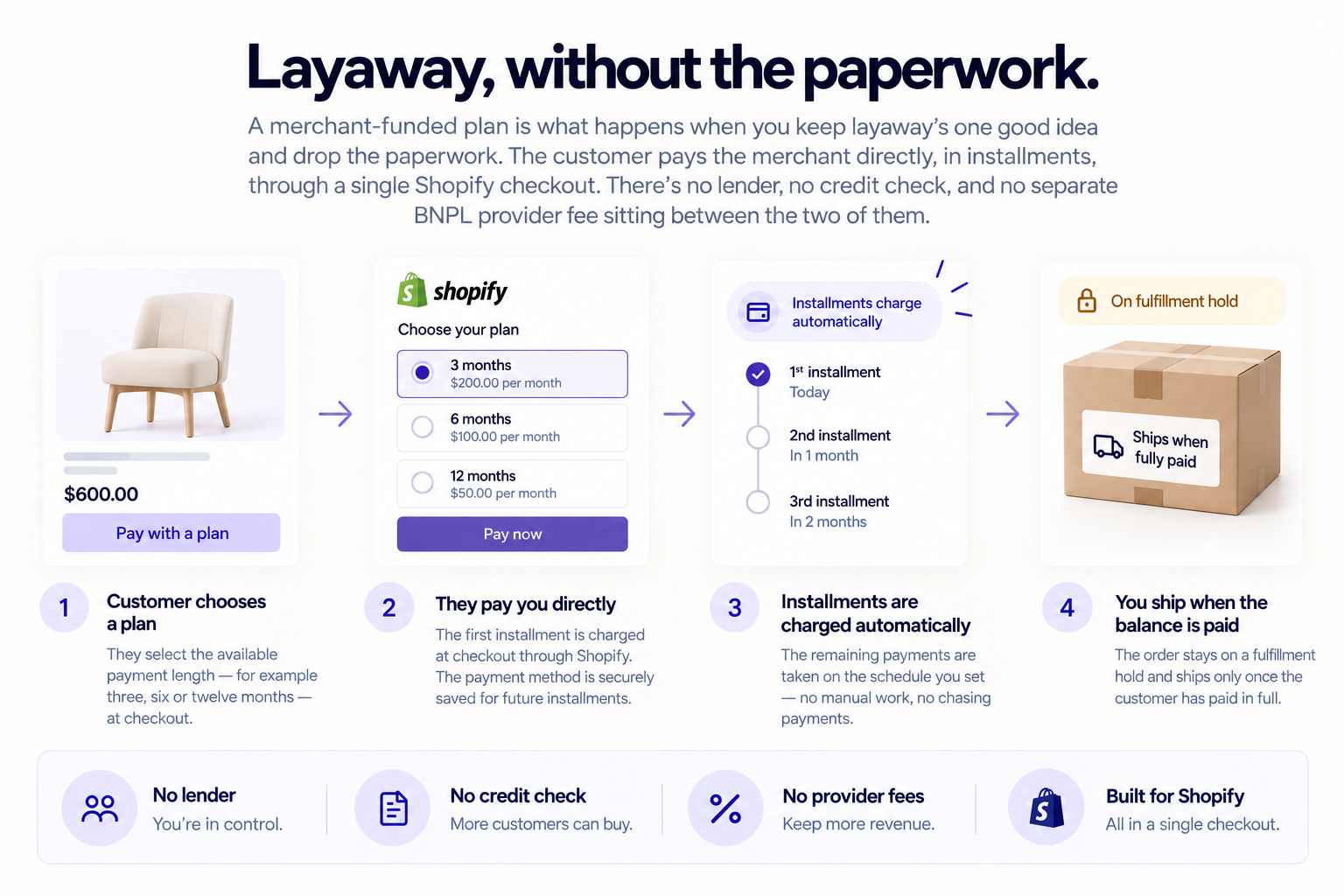
The part that borrows straight from layaway is fulfillment. The order goes on a Shopify fulfillment hold at checkout and stays there until the balance reaches zero, the same rule that kept Renata's dining set in the back room until the third payment cleared, just enforced by Shopify's platform instead of a sticky note. The part that borrows from BNPL is the payment experience: one checkout, a card vaulted securely, automatic charges on schedule, no deposit-and-return-in-person routine.
| Dimension | Layaway | Lender-funded BNPL | Merchant-funded plan |
|---|---|---|---|
| When the item ships | After full payment | Immediately | After full payment |
| Who holds the unpaid-balance risk | The store | The lender | The merchant |
| Credit check or interest | Neither | Often both, on longer plans | Neither |
That's the short version. The full cost-and-risk comparison, including what happens when an installment actually fails, lives in what happens if a customer misses a payment plan installment, with a seven-point breakdown of exposure, fees, and who does the chasing.
Which model actually fits your store
If you need the full order value on day one, or you have to ship the moment an order lands, BNPL's trade-off is the honest one to make, and there's no getting around paying a provider for it. That's a real constraint for plenty of businesses, and pretending otherwise doesn't help anyone.
If your margin can absorb being paid over time, and your stock can sit, allocated, until a plan finishes, a merchant-funded plan gets you the deposit-and-wait discipline that made layaway safe for the store, minus the sticky notes, the back room, and the in-person visits every payment used to require. You keep the customer relationship and skip the provider fee, which matters most on exactly the high-AOV orders where that fee is largest.
Frequently asked questions
What's the difference between layaway and buy now, pay later?
Layaway ships the product only after it's fully paid off; BNPL ships the product immediately and collects the remaining payments afterward. That single difference in timing is also a difference in who carries the risk: the store, under layaway, versus a lender, under BNPL.
Is layaway making a comeback in 2026?
Traditional in-store layaway has mostly disappeared from major retailers; Walmart, one of the last large holdouts, dropped it for Affirm-powered BNPL in 2021. What's returning is layaway's underlying logic, pay first, ship later, inside merchant-funded Shopify payment plans rather than at a physical counter.
Is a merchant-funded payment plan the same as layaway?
It shares layaway's central rule, nothing ships until the balance is paid, but runs it through automatic Shopify checkout installments instead of a manual deposit-and-return process. Merchants set the schedule and eligible products; there's still no lender and no credit check.
Does BNPL check the customer's credit, and does layaway?
Layaway never has, since no credit is extended; the store is simply holding an item the customer already agreed to pay for. BNPL varies: many pay-in-4 plans skip a hard credit check, but longer, interest-bearing BNPL plans typically involve one.
Can I offer something like layaway on my Shopify store?
Yes, through a merchant-funded payment plan app rather than a literal deposit counter. Getting started with Payment Plans walks through setting up schedules, eligible products, and the checkout flow.
The takeaway
Layaway and BNPL aren't two versions of the same idea; they're opposites wearing similar marketing. One waits for the money before handing over the goods. The other hands over the goods and chases the money afterward, through a lender that charges for the privilege. Retailers picked BNPL because it freed up cash and shelf space, not because it was safer, and the CFPB's own research suggests it introduced a debt risk layaway never carried.
A merchant-funded Shopify payment plan doesn't have to pick a side. It pays the merchant over time like BNPL does, and it holds the order until it's paid off like layaway did, without a lender or a credit check anywhere in the middle. For a high-AOV Shopify Plus store that can hold stock and wait on revenue, that combination is worth a look before signing a BNPL agreement out of habit.
Ready to see whether it fits your catalog? Explore Payment Plans for Shopify Plus, or install Payment Plans from the Shopify App Store.
Get started today
Ready to Bring Payment Plans In-House?
Join the first 50 Shopify Plus merchants to lock in founding pricing.
Try for free →