What happens if a customer misses a payment plan installment
A missed installment triggers an automatic recovery sequence, and the order stays on hold the whole time. Here is exactly what happens, step by step.
What happens if a customer misses a payment plan installment
If a customer misses an installment on a merchant-funded payment plan, the order stays on a fulfillment hold and nothing ships. The balance has to reach zero before the product moves. What happens to the payment depends on which app is running the plan. In Payment Plans (by PreProduct), the charge is retried automatically against the customer's vaulted card, then against any backup payment method saved on the order, and the plan reschedules itself five days out if that fails.
That first distinction is worth pinning down, because three quite different things get called payment plans and they fail in three different ways.
- Lender-backed buy now, pay later (BNPL), meaning Klarna, Afterpay, or Affirm: the provider already paid you at checkout. A missed repayment is the provider's problem to chase, and you will usually never hear about it.
- Shop Pay Installments: the same structure. Shopify's lending partner carries the collection risk, not you.
- A merchant-funded plan, which is what this article is about: the customer is paying you, in installments, with no lender in between. So the recovery runs on your side, and exactly how it runs is determined by the app you chose.
That last case is the one that stops most Shopify Plus merchants from bringing payment plans in-house. Without a lender in the middle, it feels like the collection risk lands on you. It partly does. But the shape of that risk is different from what people assume, and that difference is worth understanding before you rule the model out.
We built Payment Plans, so we have a clear interest in this answer. That also means we can be specific instead of vague. What follows is the actual recovery sequence our app runs, in order and with the timings, and it is ours rather than a description of every payment plan app on the market. Then comes the honest accounting of what a failed installment costs you, a fair comparison against BNPL, and what to put in your own missed-payment policy.
Key Takeaways - On a merchant-funded plan, nothing ships while the balance is outstanding. Shopify holds the fulfillment order for the whole schedule, and the hold is released only after the final installment clears. - A failed charge is not a single event. In Payment Plans it runs through an automatic sequence: confirm the failure, try a backup payment method, fall back to an emailed invoice if the card needs customer authentication, then reschedule the plan five days out. - If charges keep failing for more than 10 days, Payment Plans cancels the plan automatically and withdraws any outstanding invoices. - Your real exposure on a failed plan is time, admin, and reserved inventory, not shipped goods you cannot recover. - BNPL genuinely removes that exposure, and charges you for it on every order including the ones you refund. That is the trade, and it is a business decision rather than an obvious one.
What happens if a customer misses a payment plan installment?
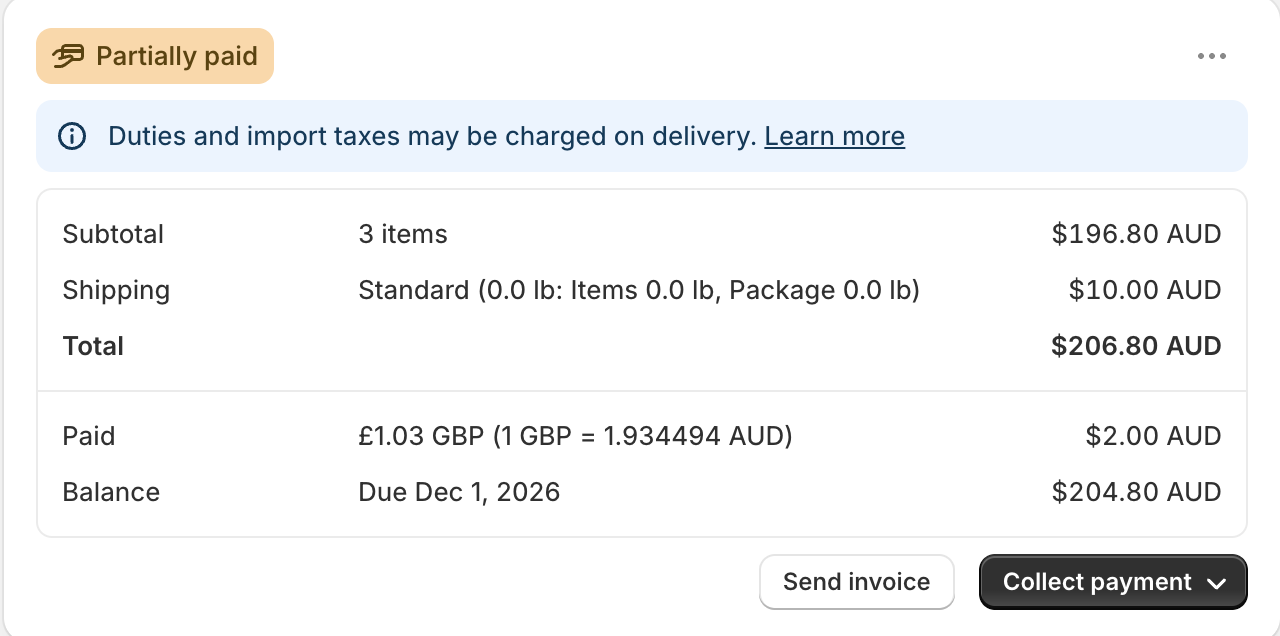
The order doesn't ship, the customer isn't sent to collections, and you don't have to notice it happened. The failed installment enters an automated recovery sequence that tries the card again, tries any other card saved against the order, and emails the customer a payment link when their bank requires them to authorize the charge in person. Every attempt is written to the plan's timeline.
The important structural point is what is happening in the background while all of that runs. At checkout, Shopify created a real order and placed its fulfillment order on hold, and it reserved the inventory. The hold doesn't lift because time passed or because most of the installments landed. It lifts on one condition only: the outstanding balance reaches zero.
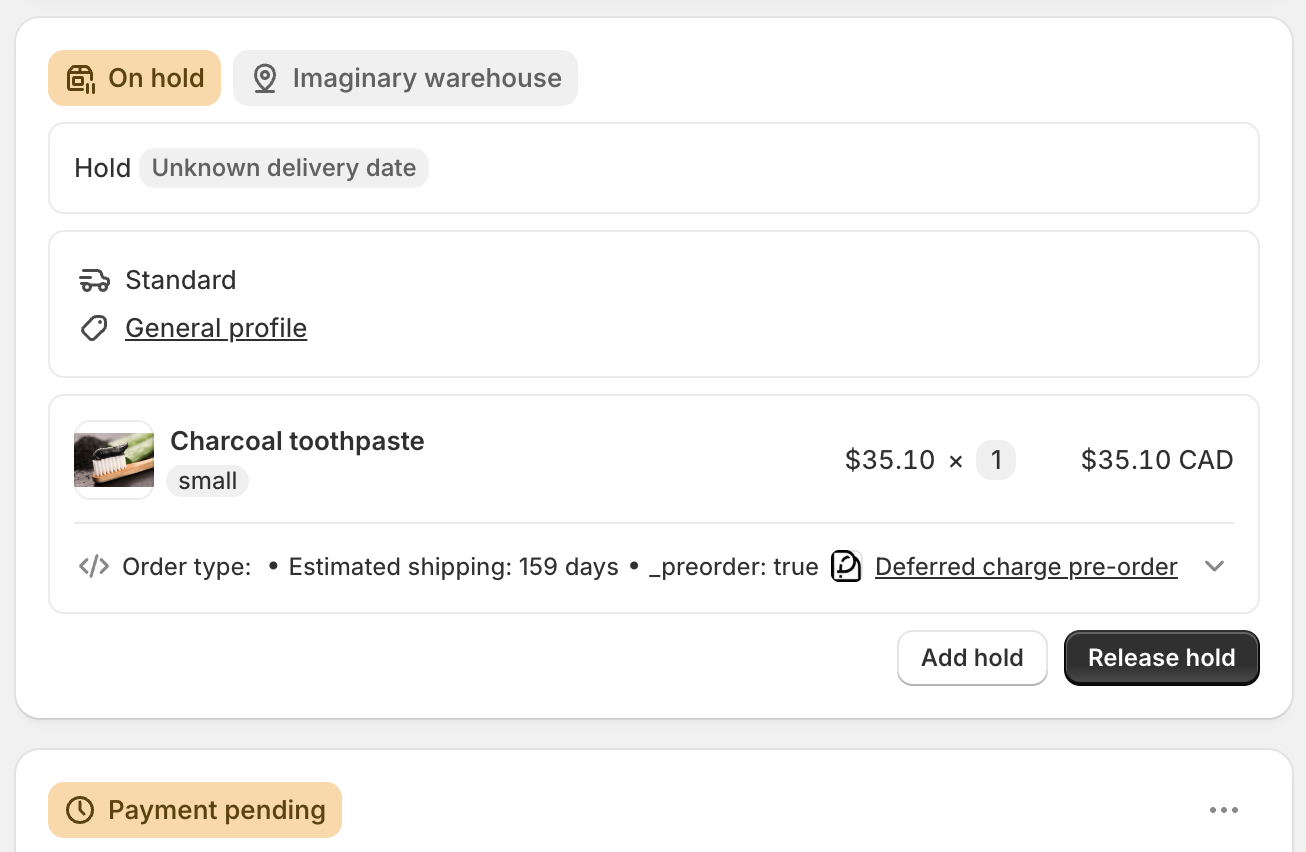
So a missed installment is a collection problem. It's never a "we shipped a $2,400 sofa to someone who stopped paying" problem.
Want to see the model end to end before the failure cases? Read how Shopify payment plans work and which route fits your store.
The recovery sequence in Payment Plans, step by step
The sequence below is how our app handles it. Other merchant-funded apps solve the same problem differently, so treat this as one worked implementation rather than a standard.
Payment plans process on a daily cycle. Each morning, every active plan with an installment due that day is picked up and charged against the customer's vaulted payment method. Here is what happens when one of those charges does not go through.
1. Confirm it actually failed. Card networks are slow and ambiguous. A charge that comes back as still processing isn't treated as failed straight away; the plan keeps checking, about four times across roughly the first hour, at widening intervals.

Only then is it recorded as a failure. That avoids the worst kind of false alarm, where a customer gets chased for a payment that was quietly succeeding.
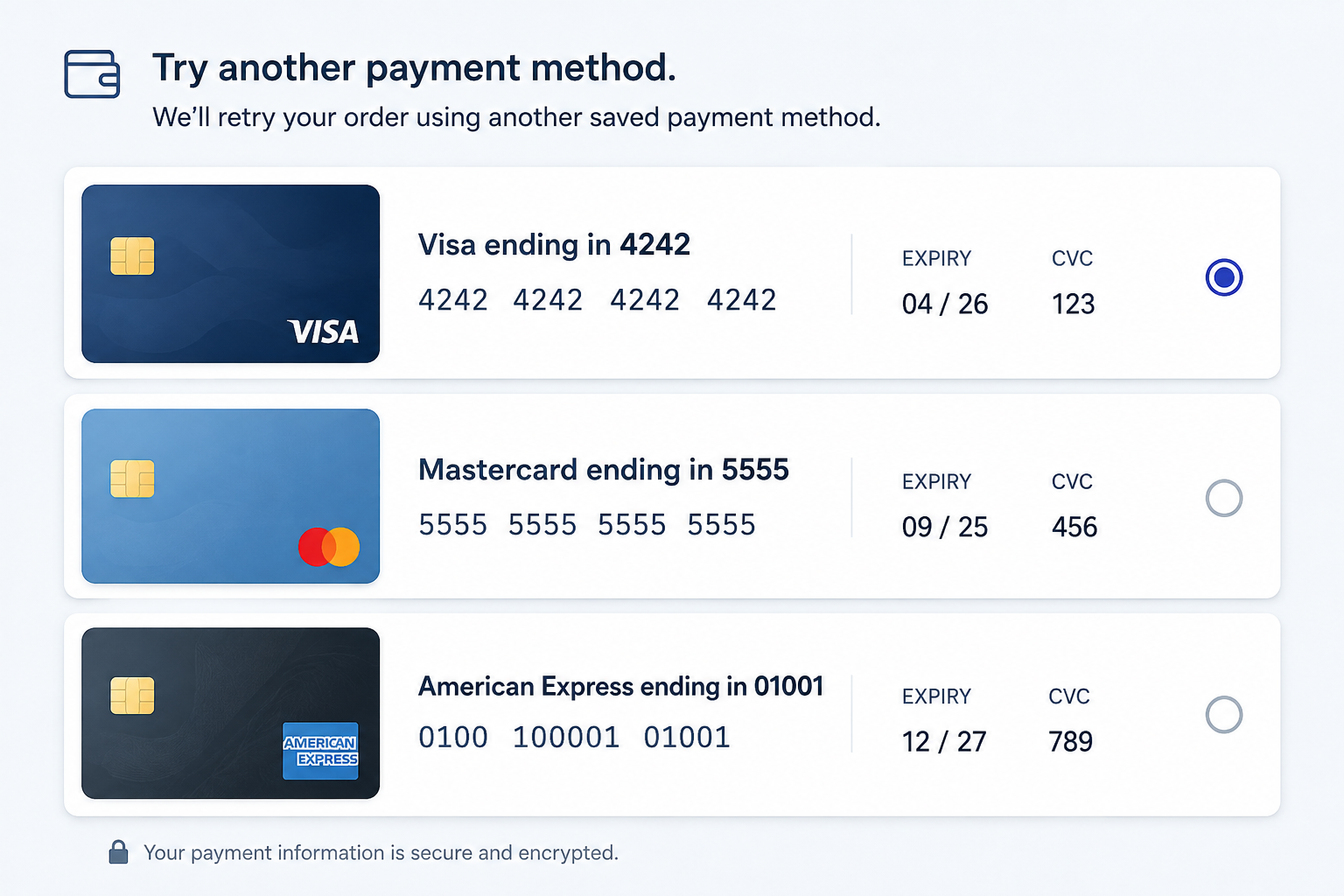
2. Try another payment method. If the customer has more than one payment method vaulted against that order, the charge is retried about a minute later against one that has not been tried yet. Many "failed" installments are a single expired or frozen card, and this step alone resolves a meaningful share of them without anyone being contacted.
3. Fall back to an invoice when the bank wants the customer present. Some declines aren't really declines. When a bank returns a response meaning "this transaction requires authentication," the card is fine but it can't be charged while the customer is away from the checkout.
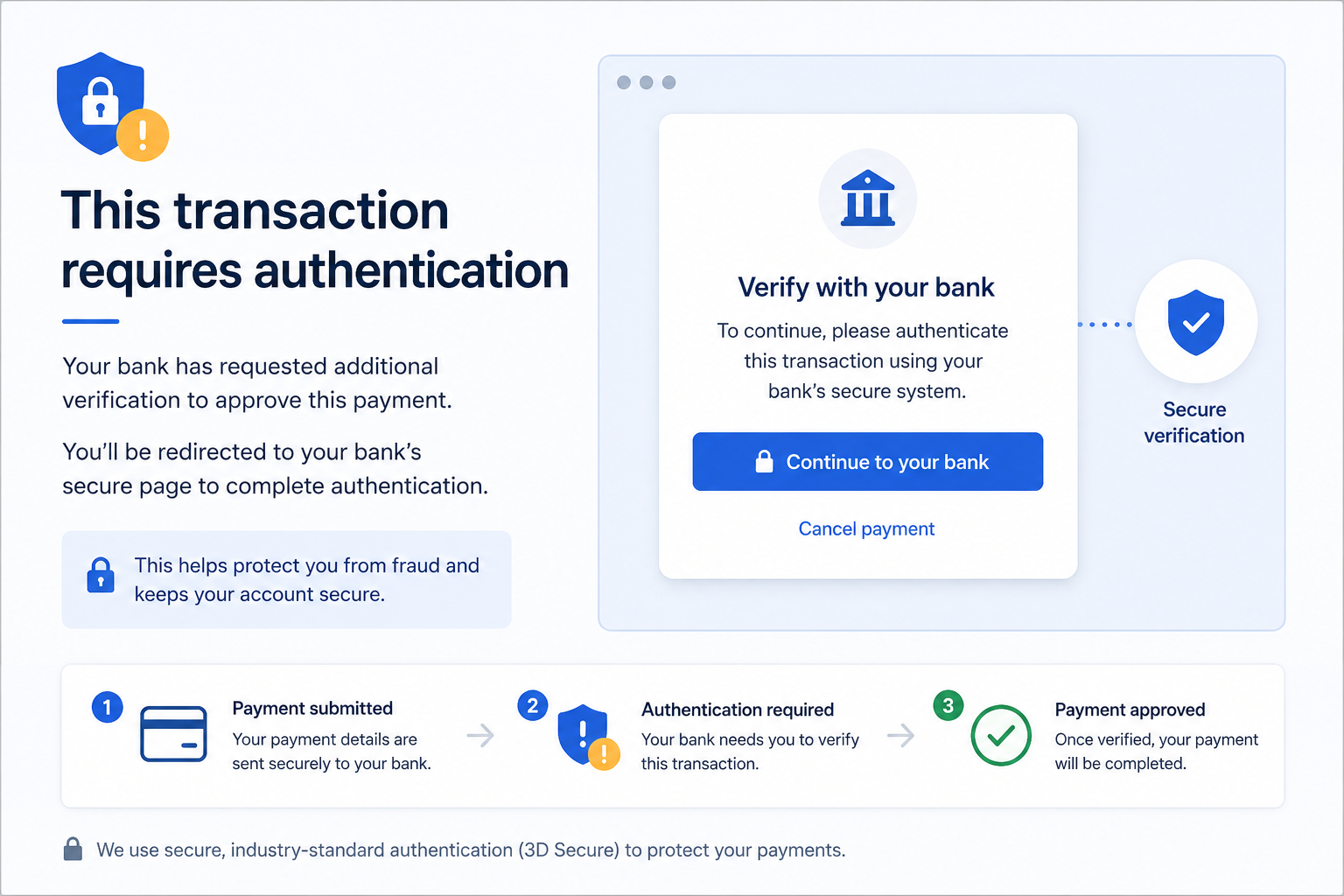
Automatic retries will never fix that, so retrying is the wrong response. Instead, the customer is emailed a Shopify invoice for the outstanding installment. When they pay it, the plan updates and the fulfillment hold releases within a couple of minutes if that payment settled the order.
4. Reschedule. If the charge failed for an ordinary reason, insufficient funds being the common one, the plan is pushed out and will try again in five days. Nothing else changes. The schedule stays, the hold stays, and the customer keeps the plan.
5. Cancel after 10 days of failure. If an installment is still unpaid more than 10 days after it was raised, the plan is cancelled automatically, any outstanding invoices for it are withdrawn so the customer cannot pay a stale link, and the cancellation is written to the timeline. This is the stopping rule. Without one, a dead plan would sit in your reporting, reserving stock indefinitely.
Consider a hypothetical. A jewelry brand sells a $1,800 piece on a six month plan, and the fourth installment fails on a Tuesday because the customer's card was reissued after a fraud alert.
Step one confirms the failure within the hour. Step two finds no second card. The decline reads as a plain failure rather than an authentication problem, so step four reschedules for the following Sunday.
The customer updates their card in the meantime, Sunday's charge clears, and the plan carries on. Nobody at the brand touched it, and the piece never left the safe.
Why the fulfillment hold is what actually protects you
Every claim so far rests on a single mechanic. We didn't invent it, Shopify did, and it's worth being precise about how it works.
When a payment plan is applied to a product, the underlying Shopify selling plan is configured as a deferred purchase option with an unknown fulfillment date. Shopify's own documentation describes the arrangement: "Shopify will store a customer's payment method so that merchants can collect the remaining balance amount without contacting the customer." Because the fulfillment date is unknown rather than immediate, Shopify places the fulfillment order on hold at checkout and reserves the inventory against it.
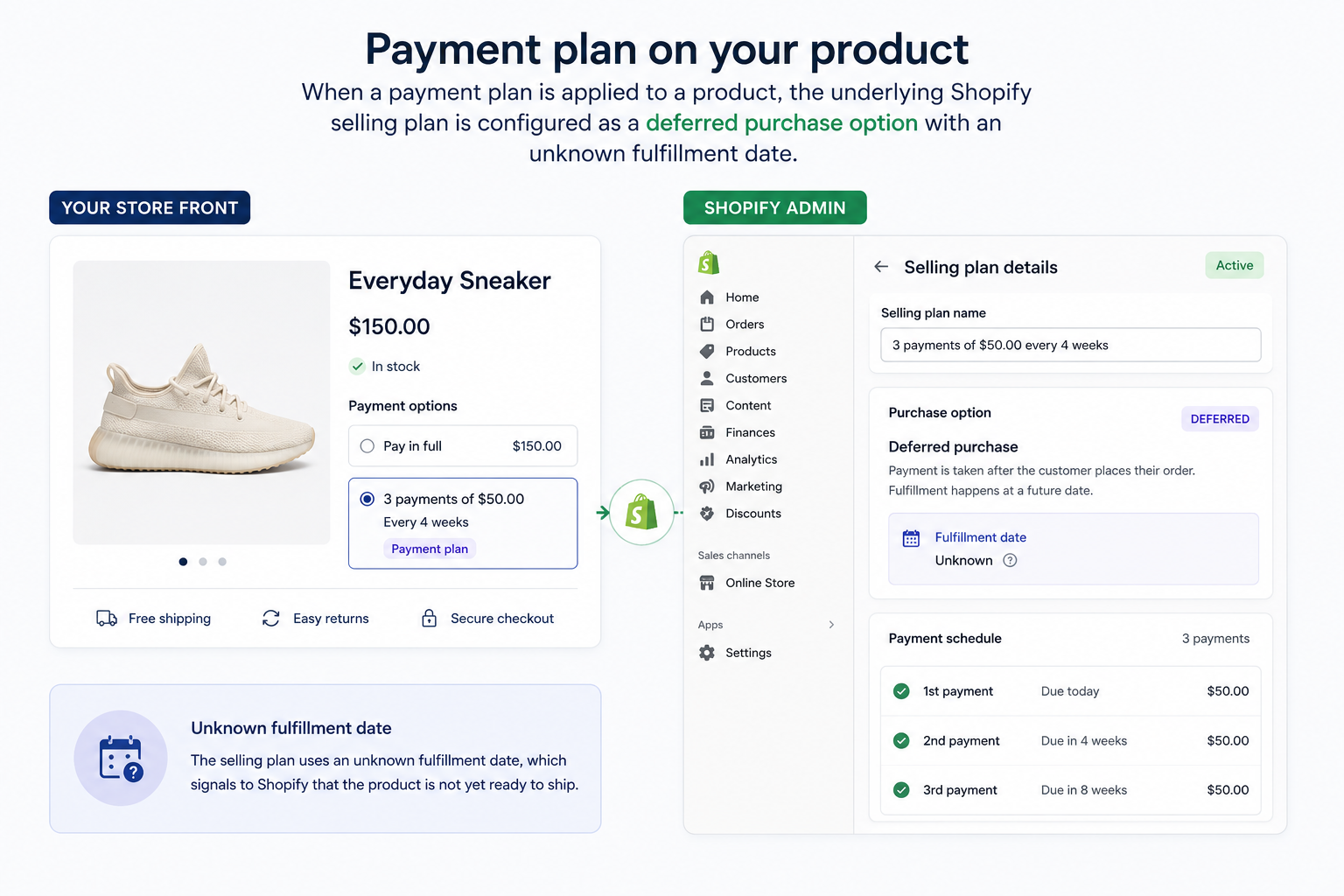
Releasing that hold is a deliberate act. It happens through Shopify's fulfillmentOrderReleaseHold mutation, which the app calls only once the order's outstanding balance is zero. The final installment is deliberately handled differently from the others: rather than charging one more equal slice, it sweeps everything still owed, including shipping and tax, so the balance lands exactly at zero and the hold can lift cleanly.

Two consequences follow, and they're the whole argument for the model:
- A partially paid order cannot be fulfilled by accident, because the hold is enforced by Shopify at the fulfillment-order level, not by a warning label on the order.
- A customer who stops paying halfway through has your inventory reserved, not your inventory.
That's why we describe the model as a modern layaway rather than as lending. The goods stay with the merchant until the money is in. Layaway solved this problem in physical retail decades ago, and the fulfillment hold is the same idea expressed in Shopify's data model.
What a failed installment actually costs you
This is the part worth being blunt about. A merchant-funded plan isn't free of downside; the downside just sits somewhere other than where people expect. When a plan fails outright, here is the real ledger.
What you don't lose: the product. It never shipped.
What you do lose:
- Reserved inventory and the time it sat reserved. If that piece was the only one in stock, you held it out of the market for the length of the failed plan. In a seasonal category, that is a genuine cost.
- Payment processing fees on the installments already collected. Standard Shopify Payments fees apply to each successful installment, and refunding the customer doesn't reclaim them.
- Admin time. Someone has to decide what to do with a cancelled plan, handle the customer conversation, and put the item back on sale.
- A customer relationship that needs handling. They committed to something they couldn't finish. How you treat that is a brand decision.
Notice that none of these are catastrophic, and all of them are bounded. The worst case on a merchant-funded plan is knowable in advance, which isn't usually true of credit risk.
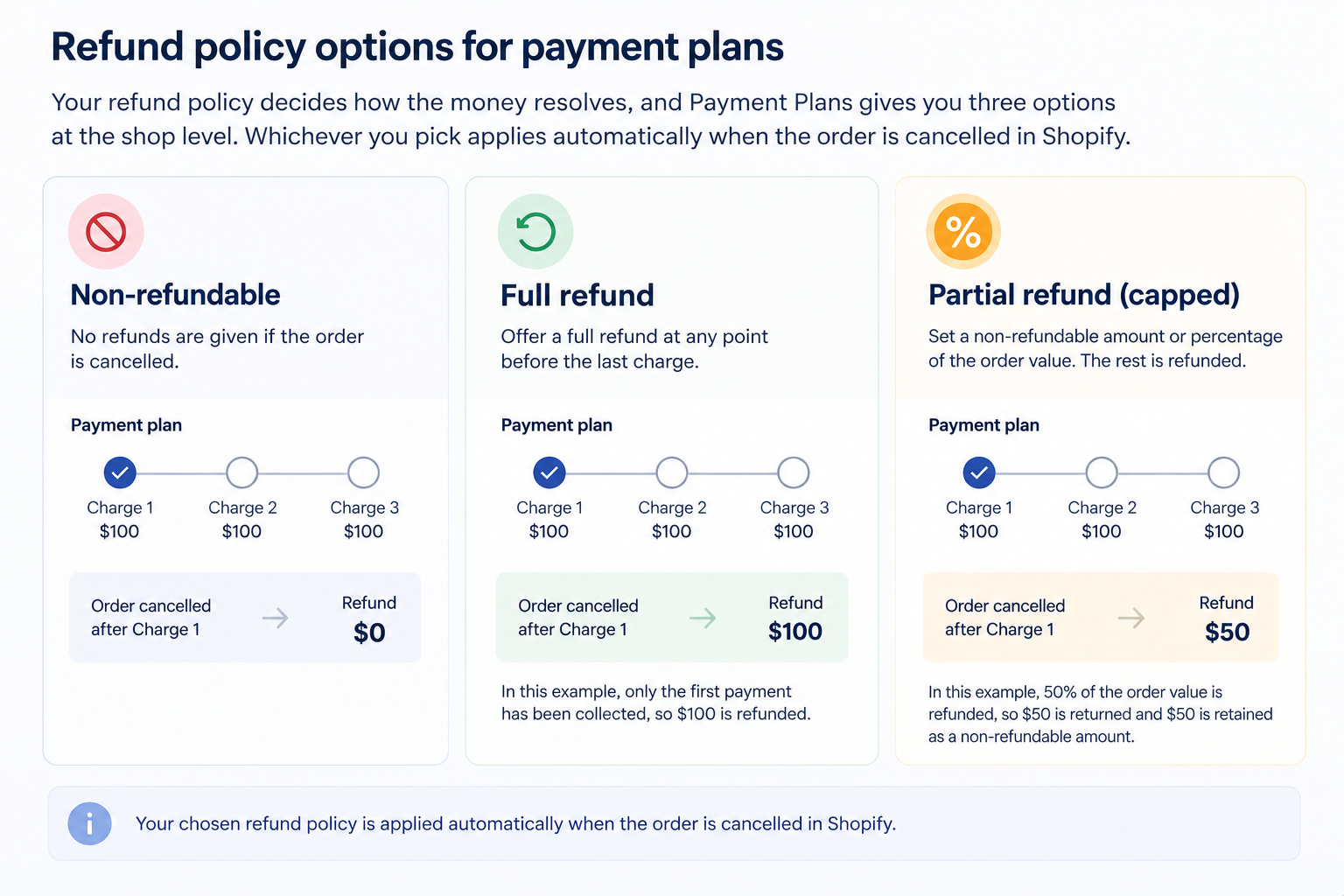
Your refund policy decides how the money resolves, and Payment Plans gives you three options at the shop level. You can make plans non-refundable, which is the default. You can offer a full refund at any point before the last charge.
Or you can cap refunds at a percentage of the order value, which is how merchants typically make the deposit non-refundable while returning the rest. Whichever you pick applies automatically when the order is cancelled in Shopify.
Payment Plans does not provide a loan or perform a credit check. Merchants should confirm that their payment-plan terms, disclosures, cancellation policy, and local setup meet the requirements that apply to their business.
Is a merchant-funded payment plan riskier than BNPL?
Yes, on one dimension: who carries the risk that the customer stops paying. A BNPL provider pays you the full order value at checkout and then owns the problem of collecting from the customer. If that customer defaults, it's the provider's loss, not yours.
Shopify's documentation confirms the speed of it for Shop Pay Installments: you receive full payment within one to three business days. You also ship immediately, which merchant-funded plans can't match. Those are real advantages, and any comparison that hides them isn't worth reading.
The question is what that transfer costs and what it is protecting you from.
| Merchant-funded payment plan | Lender-backed BNPL | |
|---|---|---|
| When you are paid | As each installment clears | Upfront, in 1 to 3 business days |
| Who chases a missed payment | Automated recovery on your side | The provider |
| When the product ships | After the final installment | Immediately |
| Exposure if the customer stops paying | Reserved inventory and admin | None, the provider absorbs it |
| Provider fee | None, standard processing only | A per-order percentage plus fixed fee |
| Fee on a refunded order | No provider fee to lose | Not returned to you |
| Who sets the schedule | You | The provider's fixed format |
On speed and risk transfer, BNPL wins outright. The trade is that you pay the provider's rate on every order, including the ones that get refunded, in exchange for removing an exposure that the fulfillment hold has already capped at reserved stock rather than shipped goods. For a merchant selling a $200 accessory with high return rates, that can be a fair deal. For one selling a $3,000 made-to-order piece from held stock, it often isn't.
We looked at what those rates actually are in what BNPL providers really charge merchants, and the short version is that none of the four major providers publishes one.
Working out which side of that line your store sits on? See how Payment Plans works for Shopify Plus.
How to reduce failed installments before they happen
Recovery is the safety net. The cheaper work is upstream, in how you configure the plans in the first place.
Keep schedules short enough to outrun card expiry. A 12 month plan will cross at least one card reissue for a meaningful slice of your customers. Three and six month options fail materially less often for the simple reason that there's less time for the card to change. If you offer 12 months, offer it alongside shorter options rather than as the default.
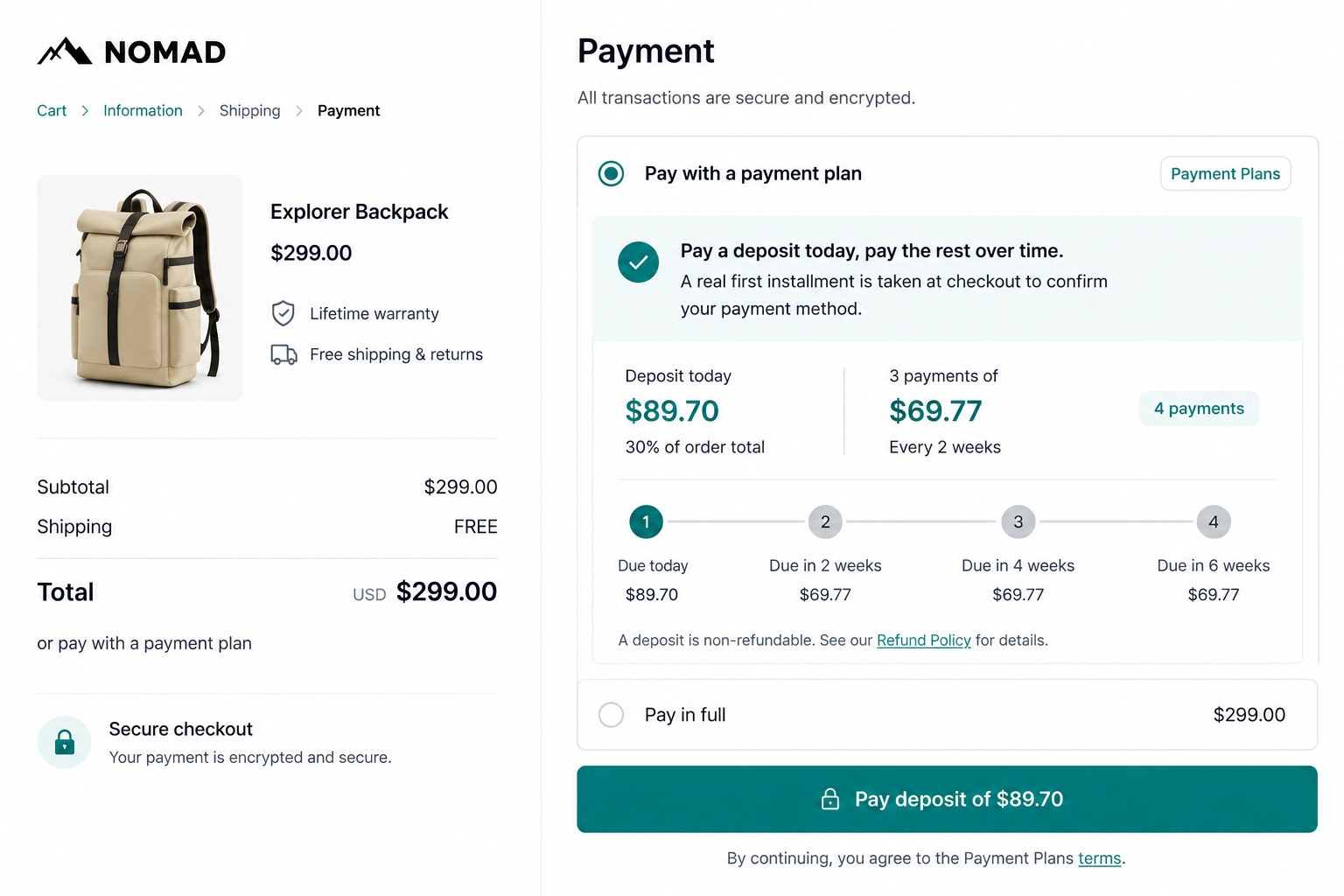
Take a real first installment at checkout. A plan whose first payment clears at checkout has already proved the card works. Configuring a deposit or a substantial first installment filters out the payment methods that were never going to complete a schedule.
Use eligibility rules rather than opening the catalog. Payment plans earn their keep on high-consideration, high-AOV products. Applying them by product tag, type, or vendor keeps them on the items where a longer schedule is worth the operational overhead, and off the $40 add-on, where a failed plan costs more to administer than the sale was worth. Getting started with Payment Plans walks through the setup.
Match plan length to how long you can hold the stock. This is the constraint merchants underweight. If you can comfortably reserve a unit for three months but not nine, that's your maximum plan length, regardless of what would convert best.
Take a hypothetical furniture brand: they launch with a single 12 month option on the entire catalog, including a $180 side table. Six weeks in, the failures cluster in exactly two places, the long plans and the cheap items. Cutting to three and six month options and restricting eligibility to products over $800 by tag addresses both at once, and the operational load drops with it.
 /
/
Writing your missed-payment policy
Whatever the automation does, customers should be able to read what happens before they commit. A workable policy answers five questions in plain language, and it can be four sentences:
- What happens on the day a payment fails. ("We will automatically try again, including any backup card you have saved.")
- How they will hear about it, and how they can fix it themselves.
- How long the plan stays open before it is cancelled.
- What happens to the money already paid if the plan is cancelled, which is your refund setting stated in words.
- When the item ships, stated explicitly. This one isn't optional. Customers must understand before checkout that the product arrives after the final payment.
Put it on the product page next to the plan selector, not only in your terms.
Frequently asked questions
What happens if a customer stops paying a payment plan halfway through?
In Payment Plans, the plan retries, then reschedules, then cancels itself if the installment stays unpaid past 10 days. The order never ships, because Shopify holds the fulfillment order until the balance is zero. What happens to the money already collected depends on the refund setting you chose: non-refundable, fully refundable before the last charge, or refundable up to a percentage you set.
Do I have to chase customers for missed installments myself?
No, though you should expect to make occasional judgment calls. The retries, the backup card attempt, the authentication invoice, and the cancellation all run automatically and are logged against the plan. What isn't automated is deciding whether to make an exception for a good customer, or what to do with a cancelled plan's stock.
Can a customer receive the product before finishing the payment plan?
Not by default, and not by accident. The fulfillment hold is enforced by Shopify against the fulfillment order, so a partially paid order can't be fulfilled in the ordinary flow. A merchant who deliberately wants to ship early can release the hold themselves in Shopify, but that's a conscious decision to take on the risk, not something that happens through oversight.
Does a failed payment plan installment affect the customer's credit?
Payment Plans does not provide a loan or perform a credit check, and there's no lender in the transaction to report to a credit bureau. Merchants should still confirm what applies in their own jurisdiction rather than treating that as universal.
What if the card was declined because the bank wanted the customer to authenticate?
That case is handled separately, because retrying it silently would never work. The customer is emailed a Shopify invoice for the installment so they can complete the payment with their bank's authentication step. Paying it settles the installment, and if it was the last one, releases the hold.
Is a merchant-funded payment plan riskier than BNPL?
On collection risk, yes: you carry it instead of a provider. On inventory risk, no, and this is the part that gets missed. Because nothing ships until the order is fully paid, a failed plan costs you reserved stock and admin time rather than a product you cannot get back.
The takeaway
A missed installment is a smaller event than it sounds. The charge is confirmed rather than assumed, retried against a backup card, converted into an emailed invoice when the bank needs the customer present, rescheduled five days out, and finally cancelled if it is still unpaid after 10 days. All of it is logged, and none of it requires you to be watching.
Underneath that, one mechanic is doing the real work. The order sits on a Shopify fulfillment hold from checkout until the balance hits zero, so the failure mode of a merchant-funded plan is a reserved unit and some admin, not a shipped product and a bad debt.
That's a genuinely different risk from the one merchants imagine when they hear "no lender." It isn't zero risk, and BNPL's upfront payment and immediate shipment remain real advantages worth paying for in some categories. But it is bounded, knowable, and mostly automated, which is usually enough to make the model workable for high-AOV stores that can hold stock.
Ready to see whether it fits your catalog? Explore Payment Plans for Shopify Plus, or install Payment Plans from the Shopify App Store.
Get started today
Ready to Bring Payment Plans In-House?
Join the first 50 Shopify Plus merchants to lock in founding pricing.
Try for free →